
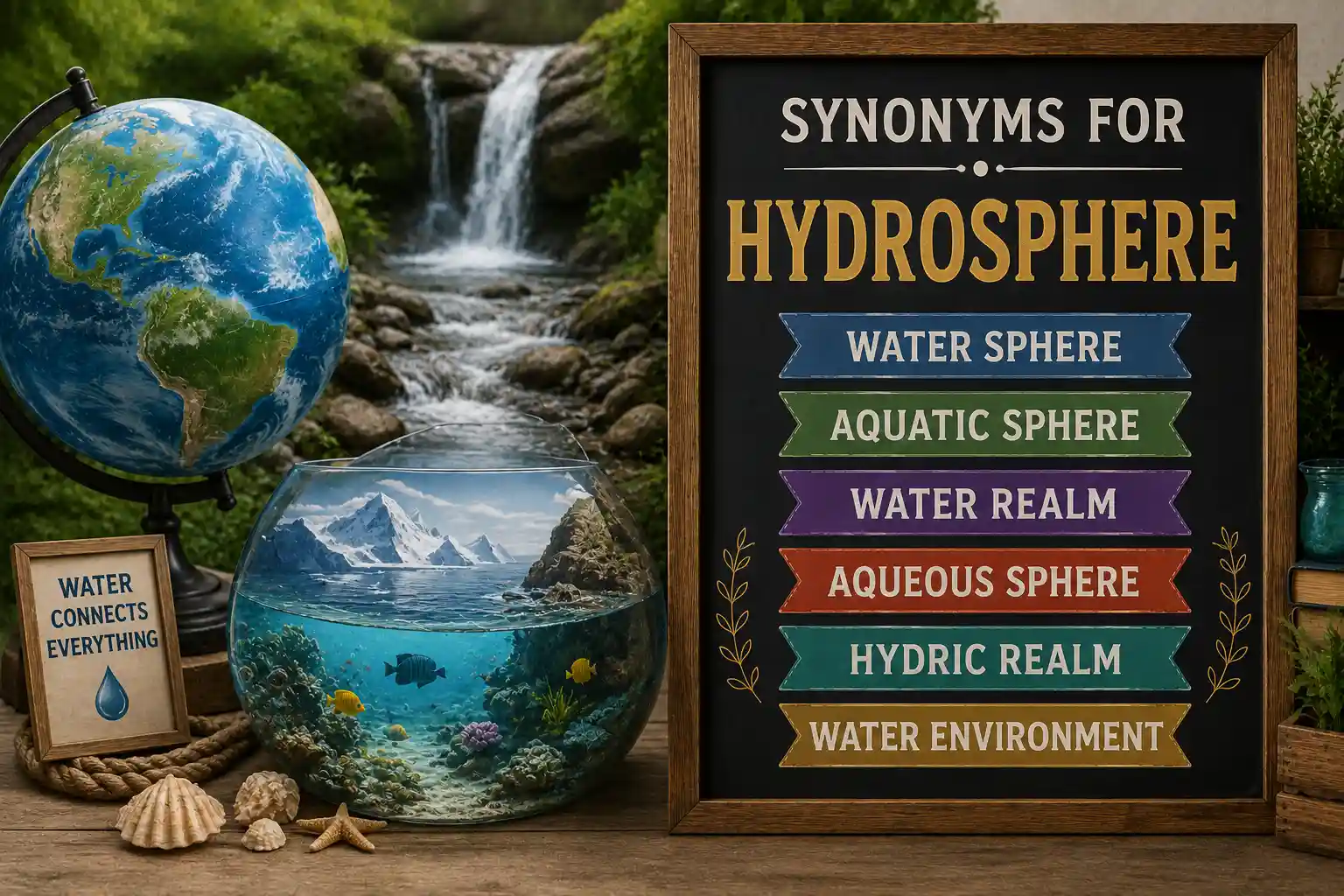
What Is a Synonym for Hydrosphere?
A synonym for hydrosphere is any word that describes Earth’s total water system. The closest matches are Earth’s water system, waters of the earth, and water envelope. These terms refer to oceans, rivers, lakes, ice, and water vapor combined. Because hydrosphere is a scientific term, true synonyms are limited compared to everyday words.
Picture this. You’re writing a geography essay, and the word “hydrosphere” shows up in every single sentence. It starts to feel repetitive fast. Have you ever wondered what other words you could use instead?
The hydrosphere is simply all the water on Earth. That means oceans, rivers, lakes, ice, and even the water vapor floating in clouds. When you say “the hydrosphere covers most of our planet,” you’re talking about this whole water system.
Learning synonyms for hydrosphere helps students write better essays, helps bloggers avoid dull repetition, and helps everyday English learners sound more confident. Since the hydrosphere is a science term, its synonyms are fewer than a normal word, but the ones that exist are genuinely useful. Let’s explore them.
Synonyms for Hydrosphere: The Full List
Because “hydrosphere” is a precise scientific term, it does not have a huge pool of casual alternatives like common adjectives do. Below are the genuine synonyms and closely related terms, grouped so you can see exactly how each one works.
True Synonyms
These words can replace “hydrosphere” in most scientific or academic sentences without changing the meaning.
Earth’s Water System
Meaning:
This means all the water found on, above, and under the Earth’s surface.
Examples:
- Scientists study Earth’s water system to understand climate change.
- Our textbook has a whole chapter about Earth’s water system.
Waters of the Earth
Meaning:
This phrase means every ocean, lake, river, and ice sheet on the planet.
Examples:
- The documentary explored the waters of the earth from the poles to the equator.
- Ancient sailors depended on the waters of the earth to travel and trade.
Water Envelope
Meaning:
This means the layer of water that surrounds and covers parts of the Earth.
Examples:
- The water envelope includes oceans, rivers, and even underground water.
- Geographers describe the water envelope as one of Earth’s four major spheres.
Aquasphere
Meaning:
This is a less common word for the same idea as hydrosphere, Earth’s total water layer.
Examples:
- The professor used “aquasphere” as an alternative term during her lecture.
- Some environmental reports use aquasphere instead of hydrosphere for variety.
Formal and Technical Terms
These words appear more often in academic writing, textbooks, and scientific reports.
Hydrospace
Meaning:
This word describes the space taken up by all of Earth’s water, especially in a technical sense.
Examples:
- The research paper referred to ocean depths as part of Earth’s hydrospace.
- Engineers studying underwater systems often use the term hydrospace.
Global Water System
Meaning:
This means the connected network of all water sources across the whole planet.
Examples:
- The United Nations report focused on protecting the global water system.
- Pollution in one river can affect the entire global water system.
Related Terms
These words connect closely to the hydrosphere but are not direct substitutes. Use them to add context, not to replace the word directly.
Water Cycle
Meaning:
This is the movement of water through evaporation, rain, and rivers, not the water itself.
Examples:
- The water cycle constantly moves water between the hydrosphere and the atmosphere.
- Teachers often draw the water cycle to show how rain forms.
Ocean
Meaning:
This is the largest single part of the hydrosphere, but it is only one piece of it.
Examples:
- The ocean holds about 97 percent of all water in the hydrosphere.
- Marine biologists explore the ocean to learn about sea life.
Cryosphere
Meaning:
This means the frozen water part of Earth, like glaciers and ice caps.
Examples:
- The cryosphere is shrinking because of rising global temperatures.
- Antarctica is one of the largest parts of the cryosphere on Earth.
Why These Synonyms Matter
Using different words like these keeps your writing fresh. Instead of repeating “hydrosphere” five times in one paragraph, you can switch between “Earth’s water system,” “waters of the earth,” or “global water system.” This small change makes essays, blog posts, and science reports easier and more enjoyable to read.
For ESL learners, knowing these alternatives also builds confidence. You start to understand how English speakers describe the same idea in several ways, which is a real sign of strong vocabulary skills.
FAQ Section
What is another word for hydrosphere?
Common alternatives include Earth’s water system, waters of the earth, and water envelope. These terms all describe the total water found on our planet.
What is a synonym for hydrosphere in earth science class?
In earth science, “global water system” and “Earth’s water system” are the most accepted formal alternatives, since they match textbook language.
Is “ocean” the same as “hydrosphere”?
No. The ocean is only one part of the hydrosphere. The hydrosphere also includes rivers, lakes, groundwater, ice, and water vapor.
What word can I use instead of hydrosphere?
You can use “Earth’s water system” or “waters of the earth” for a natural, easy-to-understand alternative in most sentences.
Why do we use synonyms for hydrosphere in writing?
Synonyms prevent repetition, keep readers engaged, and show a stronger command of scientific vocabulary in essays and articles.
Conclusion
Learning synonyms for hydrosphere makes your writing clearer and more interesting, whether you’re studying for a science exam, writing a blog post, or just chatting about our planet’s water. Try using words like “Earth’s water system” or “global water system” in your next essay or email. The more you practice, the more natural these words will feel in everyday conversation.