Have you ever become so lost in a thought, song, book, or activity that you barely noticed what was happening around you? That feeling can be described as a trance. It is a state in which a person becomes deeply absorbed, less aware of their surroundings, or mentally distant from what is happening nearby.
For example, someone listening closely to peaceful music may seem to enter a trance because their attention is completely focused on the sound.
Learning synonyms for trance can make your English more flexible. Students can use them in essays, bloggers can avoid repetition, and content writers can choose a word that fits the exact situation. Some words are close synonyms, while others describe a specific type of trance-like state.
What Is a Synonym for Trance?
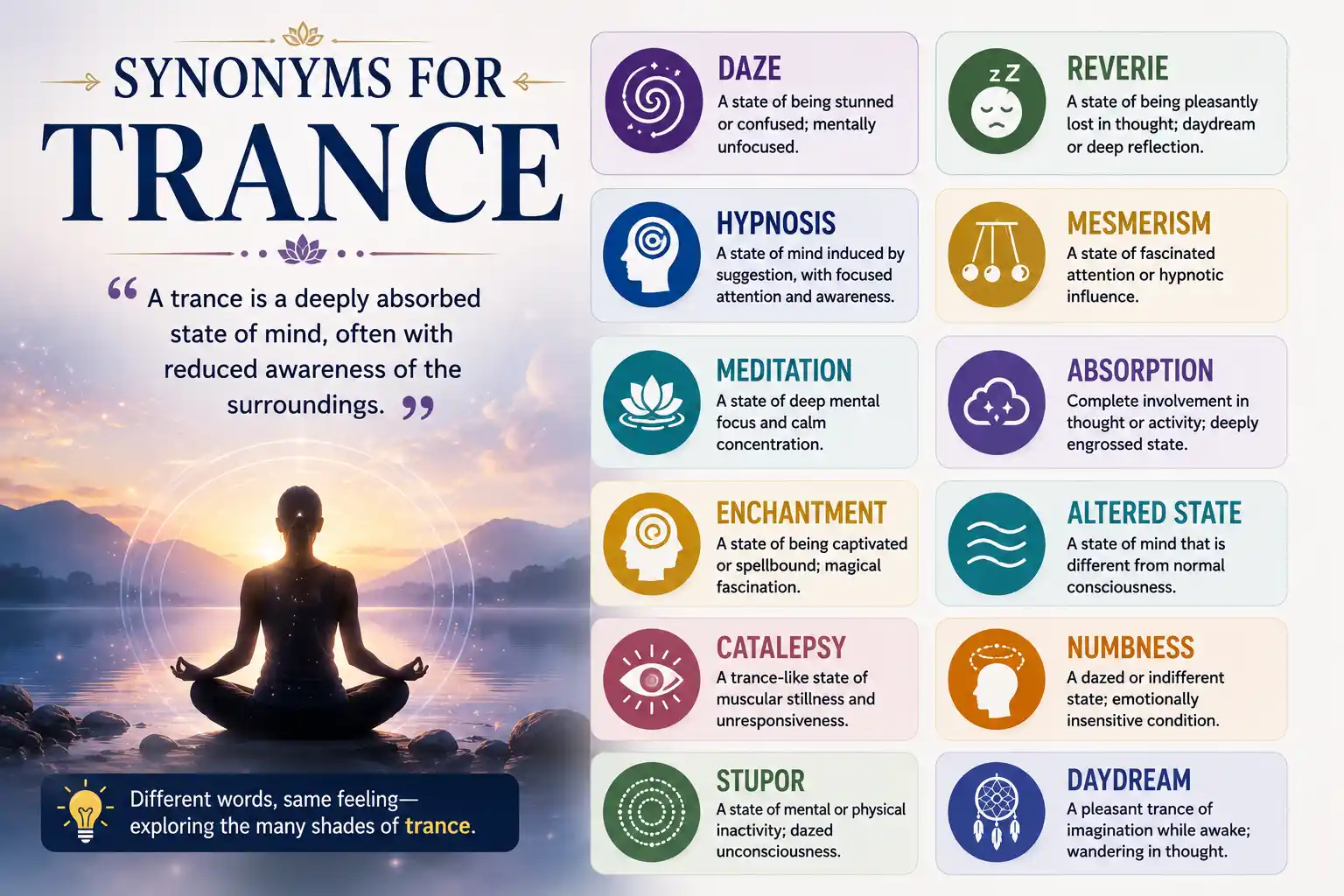
A synonym for trance is a word that describes a deeply absorbed, unaware, or altered state of attention. Depending on the context, useful alternatives include daze, reverie, hypnosis, mesmerism, absorption, enchantment, stupor, daydream, and altered state. The best choice depends on the person’s condition and the situation.
True and Close Synonyms for Trance
Daze
Meaning: A daze is a state in which you feel confused, stunned, or unable to think clearly.
Examples:
- After the sudden announcement, he sat at his desk in a daze.
- She walked through the busy station in a daze after receiving the surprising news.
Reverie
Meaning: Reverie is a pleasant state of being lost in your own thoughts.
Examples:
- During the quiet afternoon, Maria slipped into a peaceful reverie.
- He stared out of the classroom window, lost in a reverie about his summer plans.
Hypnosis
Meaning: Hypnosis is a focused mental state that can be produced through suggestion.
Examples:
- The therapist used hypnosis as part of the session.
- She learned about hypnosis while studying different states of attention.
Mesmerism
Meaning: Mesmerism refers to a state of strong fascination or hypnotic influence.
Examples:
- The audience watched the performance with a sense of mesmerism.
- His storytelling had a strange mesmerism that held everyone’s attention.
Absorption
Meaning: Absorption is a state of being completely focused on something.
Examples:
- Her absorption in the novel made her forget to check the time.
- The child’s absorption in the puzzle continued throughout the afternoon.
Enchantment
Meaning: Enchantment is a state of being completely fascinated or captivated.
Examples:
- The children watched the fireworks in complete enchantment.
- Visitors stood in enchantment as the lights appeared across the lake.
Stupor
Meaning: Stupor is a state of very limited awareness or mental activity.
Examples:
- The exhausted traveler sat in a stupor after the long journey.
- After staying awake all night, he struggled to focus and seemed to be in a stupor.
Daydream
Meaning: A daydream is a pleasant series of thoughts that takes your attention away from the present.
Examples:
- She was caught in a daydream while waiting for the bus.
- His daydream about traveling around the world made the long afternoon feel shorter.
Specialized or Related Terms
Not every word below is a perfect replacement for trance. These terms describe particular forms or related states and should be used carefully.
Altered State
Meaning: An altered state is a condition of awareness that differs from a person’s usual mental state.
Examples:
- The documentary explored how meditation can change a person’s state of awareness.
- The researcher studied different altered states of consciousness.
Meditation
Meaning: Meditation is a practice that often involves calm, focused attention.
Examples:
- She practiced meditation for ten minutes before starting her homework.
- Quiet meditation helped him focus on his breathing and settle his thoughts.
Catalepsy
Meaning: Catalepsy is a state marked by unusual physical stillness and reduced responsiveness.
Examples:
- The medical textbook described catalepsy as a condition involving marked physical stillness.
- The student learned about catalepsy while studying unusual states of consciousness.
Numbness
Meaning: Numbness is a state in which a person feels little emotion or sensation.
Examples:
- After the upsetting news, he experienced emotional numbness for a while.
- The stressful situation left her feeling a sense of numbness.
Captivation
Meaning: Captivation is a state of being strongly attracted to or fascinated by something.
Examples:
- The magician held the audience in complete captivation.
- Her captivation with the story lasted until the final page.
Spellbound
Meaning: Spellbound describes being so fascinated that you give something your full attention.
Examples:
- The students sat spellbound as the scientist explained the experiment.
- We were spellbound by the musician’s performance.
Entrancement
Meaning: Entrancement is a state of being deeply fascinated or absorbed.
Examples:
- The audience watched the dancer with quiet entrancement.
- His entrancement with the painting made him stand there for several minutes.
How to Choose the Right Synonym for Trance
Although many words are connected to trance, they do not all mean exactly the same thing.
Use daze when someone is confused or stunned. It works well after a surprising or stressful event.
Use reverie or daydream when someone is pleasantly lost in their thoughts. These words usually suggest imagination rather than confusion.
Use hypnosis when a specific hypnotic state or technique is involved.
Use absorption when someone is deeply focused on an activity, such as reading, painting, studying, or listening to music.
Use enchantment, captivation, or spellbound when the main idea is fascination.
Use stupor when awareness is greatly reduced and the person appears mentally inactive.
Use altered state when discussing changes in awareness in a more formal or academic context.
Choosing the right synonym makes your writing more precise. Instead of replacing trance with any similar-looking word, first ask what kind of mental state you want to describe.
Trance in Everyday English
The word trance can appear in many everyday situations. A person may seem to be in a trance while listening to music, watching a movie, reading a fascinating book, or thinking deeply.
For example, you might say:
- The music put him into a peaceful trance.
- She was in a trance while watching the sunset.
- He seemed to be in a trance as he worked on the painting.
However, the meaning changes slightly with context. A person who is deeply focused may be described as being in a trance, while someone who is simply imagining something may be in a daydream or reverie.
This difference is important for students and English learners because synonyms are not always interchangeable.
Why Learn Synonyms for Trance?
Knowing several alternatives helps you communicate more clearly.
For students, these words can make essays and assignments more varied without changing the main idea.
For bloggers and content writers, synonyms help prevent repetitive wording and allow descriptions to sound more natural.
For ESL and EFL learners, studying related words is a useful way to understand small differences in meaning.
For everyday speakers, the right word can make a conversation more precise. Saying someone was spellbound gives a different impression from saying they were in a stupor.
The goal is not to memorize every word. Instead, learn the difference between them and practice using each one in a natural sentence.
Frequently Asked Questions
What is another word for trance?
Common alternatives include daze, reverie, hypnosis, absorption, enchantment, stupor, daydream, and entrancement. The best choice depends on the context.
What is a synonym for trance in a relaxed context?
Reverie, daydream, and absorption can work well when the state involves peaceful or pleasant concentration.
What is a synonym for trance in a hypnotic context?
Hypnosis is the most direct term when the context specifically involves a hypnotic state. Mesmerism is a related term associated with fascination or hypnotic influence.
What word can I use instead of trance?
You can use daze, reverie, absorption, captivation, stupor, or daydream, depending on what you mean. These words have different shades of meaning.
Why do we use synonyms for trance in writing?
Synonyms help writers avoid repetition and describe different types of mental focus, fascination, or reduced awareness more accurately.
Conclusion
Learning synonyms for trance gives you more ways to describe deep focus, fascination, daydreaming, confusion, or unusual awareness. Words such as daze, reverie, hypnosis, absorption, enchantment, stupor, and daydream each add a slightly different meaning.
Practice using these words in essays, stories, blog posts, and everyday conversations. The more you notice their differences, the easier it becomes to choose the word that fits your meaning best.