What Is a Synonym for “Ever”?
A synonym for “ever” is a word that means “at any time” or “always,” depending on how it is used. Common alternatives include always, forever, at any time, and eternally. These words help writers avoid repeating “ever” too often in a sentence or paragraph.
Have you ever started a sentence and then used the word “ever” three times in a row? It happens to almost everyone. “Ever” is a small word, but it carries a big job in English. It can mean “always” (as in “ever faithful”) or “at any time” (as in “Have you ever tried sushi?”).
Learning synonyms forever gives your writing more variety and polish. Instead of repeating “ever” again and again, you can pick a word that fits the mood, whether formal, casual, or poetic. For students, bloggers, and everyday English speakers, this small swap makes a big difference in how natural your writing sounds.
Synonyms List for “Ever”
True Synonyms
These words can replace “ever” in most everyday sentences without changing the meaning much.
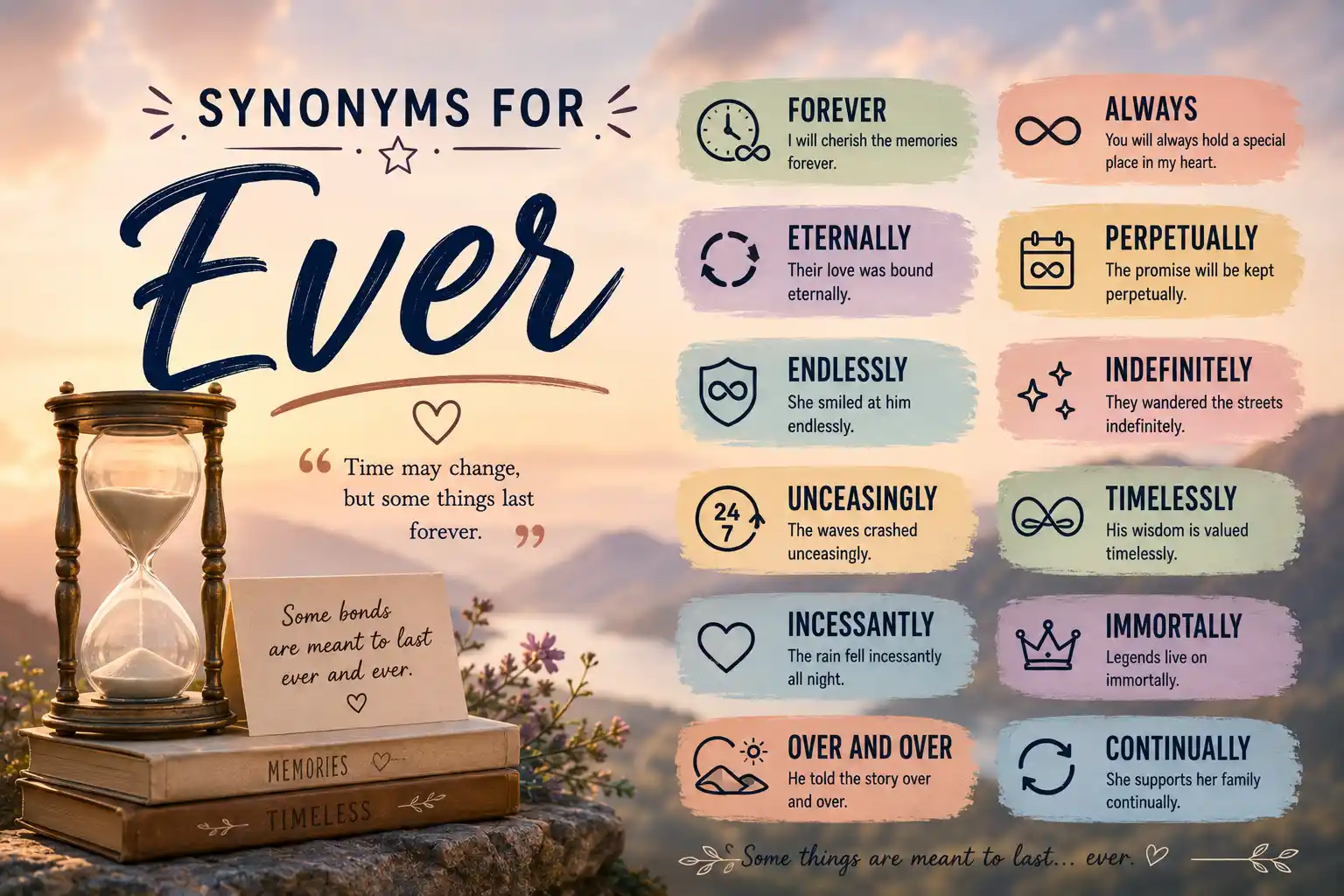
Always
Meaning:
“Always” means something happens every time, with no exceptions.
Examples:
She always answers her phone within two rings. He said he would always remember his first day of school.
Forever
Meaning:
“Forever” means for all time, without ever stopping.
Examples:
They promised to stay friends forever. The old oak tree seemed like it would stand there forever.
At Any Time
Meaning:
“At any time” means during any moment, past, present, or future.
Examples:
You can call me at any time if you need help. Has she at any time mentioned wanting to move abroad?
Eternally
Meaning:
“Eternally” means lasting forever, without any end.
Examples:
He said he would be eternally grateful for her kindness. The couple vowed to love each other eternally.
Perpetually
Meaning:
“Perpetually” means happening all the time, again and again, without stopping.
Examples:
The kitchen seemed perpetually messy no matter how much she cleaned. He was perpetually late to every single meeting.
Continually
Meaning:
“Continually” means happening often, over and over, though not without any pause.
Examples:
The phone rang continually all afternoon. She continually checked her email while waiting for the offer.
Evermore
Meaning:
“Evermore” is a poetic word that means forever, from now on.
Examples:
He vowed to love her evermore, no matter what happened. The song promised that their bond would grow stronger evermore.
Formal or Technical Terms
These words for “ever” are common in legal, academic, or formal writing.
In Perpetuity
Meaning:
“In perpetuity” is a formal phrase that means forever, often used in legal documents.
Examples:
The land was granted to the family in perpetuity. The contract states the rights will remain valid in perpetuity.
Ad Infinitum
Meaning:
“Ad infinitum” is a Latin phrase that means going on forever without any limit.
Examples:
The debate seemed to continue ad infinitum without any resolution. He joked that the meeting could go on ad infinitum if no one stopped it.
Everyday or Informal Usage
These are casual, natural-sounding alternatives people use in daily conversation.
At All
Meaning:
“At all” is used in questions or negative sentences to mean “in any way” or “ever.”
Examples:
Have you at all considered switching jobs? I don’t think she has slept at all this week.
Any Time
Meaning:
“Any time” means whenever, without a fixed moment in mind.
Examples:
Feel free to visit any time you like. Did you ever think about calling him back?
Related Terms
These words connect closely to “ever” in meaning but are not direct one-to-one replacements.
Constantly
Meaning:
“Constantly” means happening again and again, without much break.
Examples:
The baby was constantly crying during the flight. Her mind was constantly racing with new ideas.
Endlessly
Meaning:
“Endlessly” means without any stopping point, going on and on.
Examples:
The children played endlessly in the backyard all summer. He talked endlessly about his new job.
Forevermore
Meaning:
“Forevermore” is a poetic, old-fashioned word meaning from this point onward, forever.
Examples:
The legend said the river would flow forevermore. She whispered that she would remember that night forevermore.
Why Learning Synonyms for “Ever” Matters
Repeating the same word in an essay, blog post, or email can make writing feel flat. Swapping “ever” for words like always, eternally, or at any time keeps sentences fresh. It also helps ESL learners understand how English speakers naturally shift tone between formal and casual writing. Bloggers and copywriters especially benefit, since varied vocabulary keeps readers engaged and improves overall writing quality.
FAQs
What is another word for “ever”?
Common alternatives include always, forever, at any time, and eternally, depending on the sentence.
What is a synonym for “ever” in formal writing?
In formal or legal writing, “in perpetuity” or “ad infinitum” are often used instead of “ever.”
Does “ever” mean the same thing in every sentence?
No. In questions like “Have you ever been there?” it means “at any time.” In phrases like “ever faithful,” it means “always.”
What word can I use instead of “ever”?
You can use “always” for constant actions, “at any time” for questions, or “forever” for lasting situations.
Why do we use synonyms for “ever” in writing?
Synonyms prevent repetition, add variety, and help match the right tone, whether casual, formal, or poetic.
Conclusion
Learning synonyms for “ever” makes your writing sound more natural and confident, whether you’re drafting an essay, a blog post, or a quick email. Words like always, forever, and at any time each carry their own shade of meaning, so choosing the right one adds clarity and polish. Try using a few of these alternatives in your next conversation or piece of writing, and watch your vocabulary grow.