Have you ever noticed something around you and wanted to describe that feeling clearly? You may say you were conscious of the noise, the time, or the people nearby. But using the same word again and again can make your writing feel plain.
The word conscious often means aware of something or able to notice what is happening. For example, if you are conscious of a loud sound, you know that the sound is there. Learning other words for consciousness can help you express this idea with more detail.
Students can use these words in essays and conversations. Bloggers and content writers can use them to avoid repetition. ESL and EFL learners can also build stronger vocabulary by learning small differences between similar words.
What is a synonym for conscious?
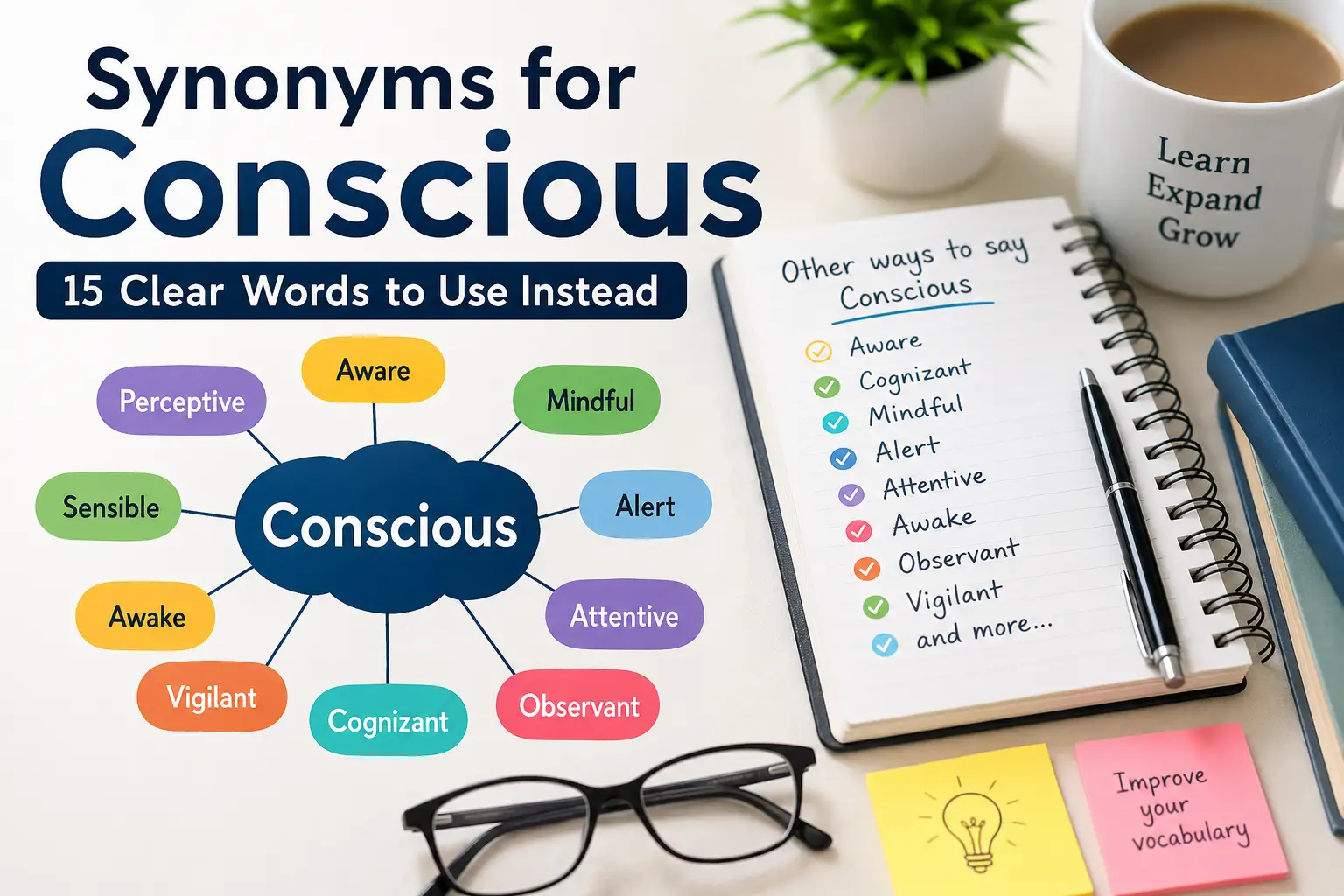
A synonym for conscious is aware when you mean knowing or noticing something. Other close alternatives include alert, mindful, cognizant, attentive, awake, and sensible, depending on the context. Some words describe being aware, while others describe being awake, careful, or aware of a particular situation.
True Synonyms for Conscious
1. Aware
Meaning: Knowing about something or noticing what is happening.
Examples:
- I was aware of the noise coming from the next room.
- She became aware that everyone was waiting for her answer.
Best use: Aware is the closest everyday synonym for conscious when talking about knowledge or awareness.
2. Cognizant
Meaning: Knowing and understanding that something exists or is happening.
Examples:
- The manager was cognizant of the problems facing the team.
- We are cognizant of the need to finish the project on time.
Best use: Cognizant is more formal than aware and works well in professional or academic writing.
3. Mindful
Meaning: Paying careful attention to something.
Examples:
- Please be mindful of the noise while the baby is sleeping.
- He is mindful of how his words may affect others.
Best use: Mindfulness works especially well when consciousness means paying attention to something with care.
4. Alert
Meaning: Fully aware and ready to notice what is happening.
Examples:
- The driver stayed alert during the long journey.
- Please remain alert when walking near the busy road.
Best use: Alert is useful when awareness includes attention and readiness.
5. Attentive
Meaning: Giving careful attention to someone or something.
Examples:
- The students were attentive during the science lesson.
- She was attentive to every detail in the instructions.
Best use: Attentive is a natural choice when conscious means actively paying attention.
6. Sensible
Meaning: Showing good judgment and awareness of what is practical.
Examples:
- He made a sensible choice after thinking about the risks.
- She was sensible enough to check the weather before leaving.
Best use: Sensible can work when conscious behavior shows good awareness and judgment, but it is not a direct replacement in every sentence.
Everyday Words Related to Conscious
7. Awake
Meaning: Not sleeping and not able to notice what is happening.
Examples:
- I was still awake when my parents came home.
- She stayed awake during the entire flight.
Best use: Awake is appropriate when conscious refers to the opposite of being asleep.
8. Waking
Meaning: Becoming awake or becoming aware of something.
Examples:
- He had a waking moment when he understood the mistake.
- She had a sudden waking awareness of the noise outside.
Best use: Waking is connected to conscious awareness, especially when someone is becoming aware.
9. Observant
Meaning: Good at noticing small details.
Examples:
- Maya is very observant and quickly noticed the missing book.
- An observant student may spot small changes in a diagram.
Best use: Observant is helpful when conscious awareness involves noticing details.
10. Vigilant
Meaning: Watching carefully for possible problems or danger.
Examples:
- The security guard remained vigilant throughout the night.
- Parents should stay vigilant near a busy swimming area.
Best use: Vigilant is stronger than conscious because it suggests careful and continued watchfulness.
11. Responsive
Meaning: Able to notice something and react to it.
Examples:
- The team was responsive to the customer’s concerns.
- The child remained responsive when the teacher asked questions.
Best use: Responsive is related to conscious awareness when the person can recognize and react to something.
Formal and Context-Specific Alternatives
12. Appraised
Meaning: Carefully noticed or judged something after considering it.
Examples:
- She appraised the situation before making a decision.
- The coach appraised the players carefully during practice.
Best use: Appraised is not a direct synonym in every sentence, but it can fit when conscious awareness involves careful assessment.
13. Perceptive
Meaning: Good at understanding things that may not be obvious.
Examples:
- His perceptive comments helped the group understand the problem.
- She is perceptive enough to notice when someone feels uncomfortable.
Best use: Perceptive describes a person who is especially good at understanding or noticing things.
14. Knowledgeable
Meaning: Having information or understanding about something.
Examples:
- The guide is knowledgeable about local history.
- She is knowledgeable about computer security.
Best use: Knowledgeable is related to conscious awareness, but it usually means having information rather than simply noticing something.
15. Intentional
Meaning: Done on purpose rather than by accident.
Examples:
- His decision to arrive early was intentional.
- She made an intentional effort to listen carefully.
Best use: Intentional is useful when conscious means deliberate or done with purpose. It should not replace consciousness when the meaning is simply aware.
Conscious Synonyms by Context
Choosing the right synonym depends on what conscious means in your sentence. A word that works in one situation may sound unnatural in another.
When conscious means aware
Use:
- Aware
- Cognizant
- Mindful
- Attentive
Example:
Instead of saying, “She was conscious of the problem,” you can say, “She was aware of the problem.”
When conscious means awake
Use:
- Awake
- Alert
Example:
Instead of saying, “He was conscious after the accident,” the word awake may fit when you simply mean that he was not sleeping. However, in medical contexts, consciousness has a more specific meaning, so replacing it requires care.
When conscious means careful about something
Use:
- Mindful
- Attentive
- Vigilant
- Observant
Example:
“She was conscious of her surroundings” can become “She was mindful of her surroundings.”
When conscious means deliberate
Use:
- Intentional
- Deliberate
Example:
“The change was conscious and planned” may be better expressed as “The change was intentional and planned.”
How to Choose the Right Word
Not every synonym has exactly the same meaning. This is important when you are writing an essay, blog post, email, or social media caption.
Aware is usually the safest everyday replacement. It clearly shows that someone knows about something.
Cognizant sounds more formal. It is useful in business, academic, and professional writing.
Mindfulness suggests careful attention. It often appears with words such as of, about, or toward.
Alert suggests readiness to notice something, especially a change, problem, or danger.
Attentive focuses on giving attention to a person, task, or detail.
Awake should be used when the main idea is not sleeping.
Intentional should be used when the idea is purpose or choice.
This small difference can make your writing much more accurate. Instead of replacing conscious with any similar-looking word, first ask what you actually mean.
Why Use Synonyms for Consciousness?
Using synonyms can make your English more natural and precise. If you repeat consciously several times in one paragraph, your writing may feel repetitive.
For students, synonyms can make essays more varied. For bloggers, they can help create smoother sentences. For content writers, they can make explanations clearer and more specific.
Synonyms are also useful in everyday speech. You may choose to be aware in a simple conversation, mindful when giving advice, or cognizant in a formal report.
The goal is not to use difficult words. The goal is to choose the word that communicates your exact meaning.
Quick Conscious Synonyms List
Here is a simple reference when you need another word for conscious:
- Aware knowing about something
- Cognizant formally aware of something
- Mindful carefully aware
- Alert aware and ready to react
- Attentive giving careful attention
- Sensible showing good judgment
- Awake not sleeping
- Waking becoming awake or aware
- Observant good at noticing details
- Vigilant carefully watching for danger
- Responsive able to notice and react
- Appraised carefully assessed
- Perceptive quick to understand or notice
- Knowledgeable having information or understanding
- Intentional done on purpose
Frequently Asked Questions
What is another word for consciousness?
The most common everyday synonym for conscious is aware. Depending on the context, you can also use alert, mindful, attentive, or cognizant.
What is a synonym for conscious in everyday English?
Aware is usually the best choice in everyday English. It is simple, natural, and easy for most speakers to understand.
What word can I use instead of conscious in formal writing?
Cognizant can work well in formal writing when conscious means aware or informed about something. Mindfulness may also fit when careful attention is the intended meaning.
Is awake a synonym for conscious?
Sometimes, but the two words are not always interchangeable. Awake mainly means not sleeping, while conscious can mean aware, awake, or mentally aware depending on the context.
Why do we use synonyms for consciousness in writing?
Synonyms help reduce repetition and make your meaning more precise. They also allow you to choose a word that matches the tone and context of your writing.
Conclusion
Learning synonyms for consciousness can make your English clearer, richer, and more flexible. Start with simple choices such as aware, alert, mindful, and attentive, then learn formal words such as cognizant when you need them. Practice these alternatives in essays, emails, blog posts, and daily conversations. The more you use them, the easier it becomes to choose the right word naturally.